
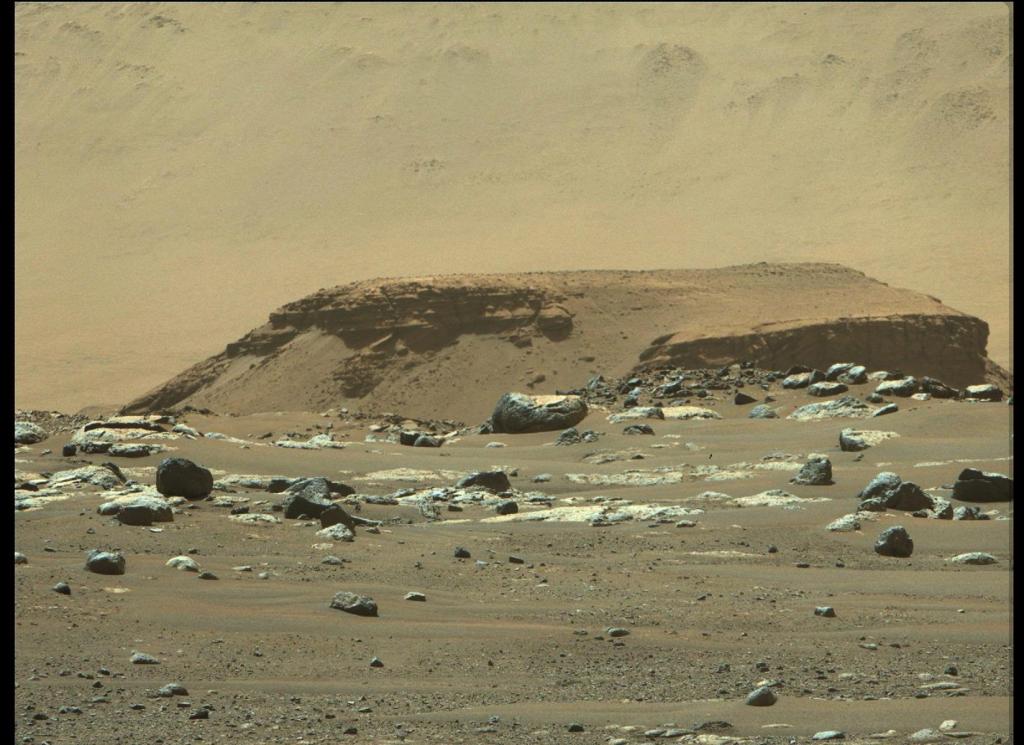
Scientists working with the Perseverance rover on Mars have found what they consider to be “potential biosignatures”, a sign that there may have been life on the red planet at some point in its past.
Billions of years ago, Mars was a water planet, much like Earth is today. When looking at the surface, old river beds and canyons can still be seen, carved out by this ancient water. Where one of these rivers once flowed out into a lake, in what is called Neretva Vallis, the Perseverance rover investigated mudstone that was deemed to be of interest.
Within these rocks, researchers found what they described as ‘leopard spots’ made of two minerals, vivianite and greigite, both of which are materials filled with iron. Both of those materials can also be found on Earth and can be produced by life. Though we also understand how they could be made without the presence of life, those methods were ruled out by noticing that the surrounding rock hadn’t been altered by the temperatures and pressures needed.

I usually try to write these articles in a less personal tone, but this is important enough to break the pattern. We have not yet found alien life, as some other news sources have claimed. We have, however, found some of the most compelling evidence to date for life outside of the Earth.
If this were to be confirmed as a sign of ancient life, essentially a fossil on another planet, this would be groundbreaking for so many fields of science. We will have found a second data point. All of our beliefs and findings about how life began are based only on our understanding of what life is like here on Earth.
Finding it elsewhere would give us a much better idea of many things. What the early Earth could have been like, how life can get started anywhere else in the universe. Finding life so close to us, within the same solar system, would essentially prove that the universe is full of places that can have living things.
We have had findings similar to this one before. Back in 2020, it was announced that there was a possible biosignature in the atmosphere of the planet Venus. That result was unable to be replicated because the equipment used wasn’t particularly well suited for observations of the planet.
It’s for reasons like this, as well as possible unknown causes of our findings, that we must be careful when announcing possible alien life. Though this is an exciting time, it is important to exercise caution. Using these minerals to claim that we have found proof of alien life is like seeing a cloud and claiming to have discovered an ocean. Is that one possibility? Absolutely, and one that is worth continued investigation. But just because we haven’t found another explanation, doesn’t mean there isn’t one.
Extraordinary claims require extraordinary evidence, as is often said. And though this is the most extraordinary evidence we have so far, how sure can we be that this isn’t just weird chemistry rather than life? Much more research will be required and is currently being done. Perseverance is just one in a long line of Mars explorers designed to discover more about the red planet and hopefully find that smoking gun that shows we aren’t alone.

 Snippets of Science
Leave a comment