
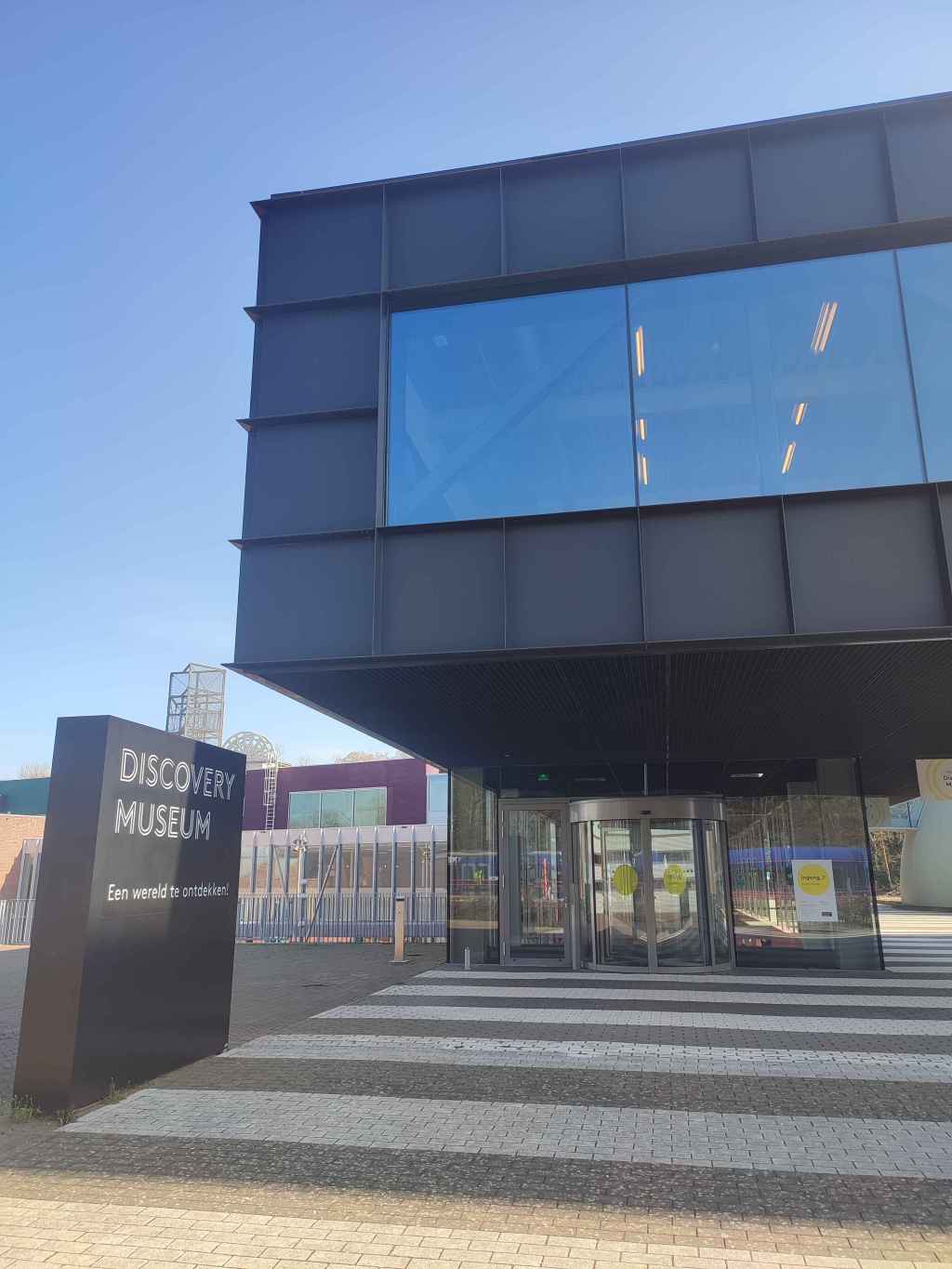
The Discovery Museum is the first dedicated science centre I’ve been to in the Netherlands, and was a very fun time and experience. I currently don’t speak Dutch which was a bit of an issue as half of the exhibits didn’t have any English translation, though as Kerkrade is on the border with Germany (I crossed the stream that marked the boundary myself), there were German translations for everything.
The exhibition starts strong, bringing you through a hallway filled with the evolution of technology, eventually leading to a very attention grabbing demonstration of pressure, allowing you to lie on a bed of nails. It leads on to a small corridor that shows various brain teasers and illusions. This part was intriguing, allowing kids to explore various 3D problems with their own hands giving them the opportunity to organically begin thinking creatively, preparing them for the rest of their visit.
From here, the exhibition splits into four. The Lab, an area for kids to do their own experiments (though I did not experience this myself as I am a 27 year old man without kids and didn’t feel like explaining my reasons for wanting to do it), the AI exhibition, the Schatkamer, and the Expeditie.
In the Schatkamer, they were displaying a series of engines, largely made for steam and diesel. This was the area I understood the least of, as the entire room was only written in Dutch. In most other scenarios, I would put that on myself. However, as part of a science centre with a large focus on entertaining and engaging children, it is important to have more than just placards with writing on them. There were some buttons you could press, an old-timey camera that you could watch videos on, a statue that had a face projected on that could give you a lecture, and two signal lights that perhaps a family could use to try and communicate with each other. I do not believe that was enough, especially as this room appeared to be the intended path by which you could get to the most objectively fun part of the science centre, the Expeditie.
This room, or perhaps series of rooms, was genuinely some of the most interesting and engaging displays I had seen in a science centre, with so many unique ideas being shown one after another. A skit of smart home appliances having an argument. A video game where you need to make sure the right things were flushed down the toilet. A table where you could attempt to build something that would survive an earthquake, and then test it by pressing a button and making the table shake violently. And that was all just in the third section. Every vignette touched on a different aspect of science and how it affects people directly.
At the very start of the room, you receive a piece of paper that you insert into small slits and punch holes in them to indicate your opinion on the things you’ve learned about. Some of these opinions are written to be rather leading, but this is one of my favourite systems I’ve ever seen. At the end, you can automatically put it in to their computer system to make people feel like they are part of science, and then you can take it home to remind you about everything that you did, always keeping it fresh in mind. This single piece of paper with holes punched in is an answer to the question, “How do we keep the stuff they learned in their minds?” I have mine in front of me right now, it’s how I remembered what was shown in the Expeditie. This is something that could absolutely be replicated at smaller venues as a way to maximise the impact they have on their visitors, and I recommend others look at what makes it work and understand why it works so well.

Unfortunately, after the praise comes the weakest part of the work presented at the venue: The AI Exhibition. Full disclosure on where I stand on the topic of generative AI (the work largely presented at the Discovery Museum): I am against it. I do not believe that it holds a place in a society that claims to respect art and integrity, being used by others in lieu of giving work to artists who have spent years honing their craft. I hope that my issues with this exhibition clearly go beyond my own personal dislike of the subject matter.
When a technology this revolutionary and controversial appears, it is our duty as science communicators to make sure that the various sides are heard and understood. Despite being among the most common criticisms of the technology, I did not see a single mention of the work this takes away from artists and creatives in the entire exhibition. At no point was this brought up, even if it were to be debunked. When I create things relating to the subject of climate science, another controversial topic, it would be remiss of me to ignore the many people who deny it. I then bring up arguments to counter it with research, as is the appropriate thing to do. The Discovery Museum does not attempt to do this with sceptical views of AI. Why they fail to do this, I do not know, though there are larger patterns in science that can explain it.
Science has often ignored the arts and culture. Rigorous study of science communication didn’t even begin in earnest until about 30-40 years ago. Science communication was scientists assuming they knew what was best for the world, and believing that telling others their view would fix everything. Here, we see a similar trap. Scientists and AI researchers have ignored the view of artists and regular people in their belief that the only thing stopping people from believing in the value of AI is that they simply don’t understand it. These researchers have trouble seeing beyond their own view here, as the major point of dissent mentioned in the AI exhibition is how it may end the world, a belief shared by the CEO of OpenAI Sam Altman. (I personally find it concerning that some of the most influential funders and beneficiaries of the success of AI believe it could end the world, but I digress).
There were other features of the AI exhibition I found notable. At the start of it, a kiosk appears to attempt to scan your face and asks for your name. It seems like it is supposed to then follow you to various terminals, and then asks you to scan yourself back out once you leave. This did not work for me, none of the terminals seemed to remember me, and scanning out simply failed to connect to the network. There was a hallway dedicated to AI video that was clearly trying to showcase the beauty of it. I understand that art is subjective, but I had truly never seen videos more nauseating. They were clearly generated on older models, and if they want to make an argument for the value of AI art, those videos need to be updated with the newer technology. There was one cool exhibit where they show a 3D model of a neural net for image recognition. You can press buttons to draw a number, and the computer recognises what number it is. It was very impressive, but I couldn’t get it to recognise the number 9, no matter how hard I tried.
I know I spent a lot of time discussing the things I disliked, but all in all most of the exhibits were engaging and intriguing. It had its issues, with various systems that weren’t functioning properly and areas that weren’t as engaging as they could have been. But it also had some genuinely unique takes on public engagement and creativity behind so many of the installations. For this reason, I give the Discovery Museum in Kerkrade, Limburg, a 4 out of 7. If you happen to be in the area around Maastricht, this is a good way to spend a few hours, especially with curious children.


 Snippets of Science
Leave a comment