
I don’t really know where to begin here. This is almost a combination of news article and blog post, so I’m calling it both. It’s been an odd week, for sure.
At the bottom of the page, you’ll find the original article I had written. I don’t want it to go to waste, so I will share with you what I consider to be one of my failures. I found what, on the surface, appeared to be an interesting article about possible early domestication attempts. I had written this up, linked it with a few other sources, and was about ready to publish the article when I found something, a response to the original paper. I opened it, didn’t fully understand it, so I emailed the lead author of the response. This is no longer a story about wolf domestication, but about the responsibilities of scientists and journalists.
Don’t get me wrong, the science in the original article is still sound. There were wolf bones that were found in a cave on an isolated island. They were smaller than average for a wolf, and they weren’t very genetically diverse. The implication of the original article is one that claims to have found a mechanism by which humans domesticated wolves, but leaves open the possibility of natural methods in which these have come about.
The response to this article argues that their conclusions are incorrect, that it is more likely to have been natural rather than involving human intervention. Beyond that, however, the authors of the response say that the way in which the original argument was worded could lead to a frenzy in the media.
Hi, that’s me, I’m the media.
In a healthy information environment, I believe that the original article could have presented both of these as possibilities in a clearer manner. We do not live in a healthy information environment. We live in a world where clicks, views, and (in the scientific world) citations are the best method to maintain funding. So by the time the story got to me, I didn’t see a possible explanation for why some wolves may have been in an isolated cave, I saw what could have been an answer to how dogs were domesticated.
I’m no expert in the field of ancient wolves, nor the methods by which they travel, so I need to rely on the interpretations of others in order to figure out the context in which these findings take place. In many cases, this only includes the interpretation by the original study authors and perhaps the interpretation by the authors of the press release, who often have more access to the researchers than I do. There is a perverse incentive structure here, though. The scientists can be incentivised to look for exciting and newsworthy things, and the press release authors are incentivised to take their data and draw wider conclusions that go outside of the bounds of the original study.
It does not feel good to almost be a part of that. If you would like a comparison between the claims of the original paper, and the possible other explanations besides human interaction, I will provide them below. After all this work I’ve now put in to what was meant to be a short news article, it feels like the least I can do. I advise you to not form an opinion based on this, as this is an active debate being had by people who have spent their lives studying this. It will not be resolved by me or most of my readers.
Claims of original paper
1. This is an unusual place for wolves to be, on an island so far from the mainland.
2. It’s odd for wolves to have this level of marine life in their diets, like fish and seals.
3. The wolves are smaller than most, which is in line with what we know about domestication.
4. It’s rare to find wolves along with human artifacts.
5. Their genetics indicate a small population, much like what you would expect if humans were attempting to domesticate them.
6. There is evidence of care as structures on the bones appear as though the bones were injured and then healed.
Response paper refutations
1. There are reports of wolves travelling almost that far over ice, it’s just a bit unusual.
2. Most of our wolf studies are on inland wolves, and coastal wolves seem to act differently.
3. While they are smaller, they aren’t quite as small as they should be if they were being domesticated.
4. It may be slightly unusual, but they aren’t that rare to find.
5. If these wolves travelled to the island on their own, then they would be quite isolated naturally, and thus have a small population.
6. The marks on the skeletons are nothing more than fairly normal wear and tear.
This also brings up my own incentive structure. I would very much like to continue to have access to these scientists. As a journalist, this can be difficult, as criticism as public as this could lead to less funding for them, and thus making them less likely to speak with me.
While these incentives remain as they are, I believe that scientists, press release authors, and journalists all have responsibilities to the public. The rate at which misinformation can spread and that a small claim in a paper can become a groundbreaking discovery has never been faster. I believe that scientists need to be more clear in their papers about the limits of their study perhaps having non-experts read their paper and see if there is a misunderstanding. Press officers must make sure that what they are writing is in fact supported by the research they are sharing. Journalists should read the paper they’re reporting on and ask related experts if they are confused or don’t understand certain aspects. If you can’t get access to a paper, you can always email the lead author, they are often more than willing to share it with you.
And for the audience, there is one thing I ask of you. When you are reading anything, even if it was posted by a reputable source, approach it with some level of scepticism. Particularly if the headline is making a very big claim. Compare it with other sources and see if the facts line up. If you have the time and energy, check the journalist’s sources too, make sure they are reporting with accuracy. Even, no, especially if you agree with what they are saying.
I should finish off by saying that everyone I have discussed is an esteemed scientist, who probably want what is best for science and the world. Scientists disagree all the time, which is what science is about. When they disagree, we can find where the truth lands.
And finally, a massive thank you to Dr. Luc Janssens, for answering my email and providing some behind the scenes details which have allowed me to see where the large scale issue lies more clearly. I have a bigger piece about issues in science journalism coming, but that won’t be for a while.
Original Article
Humans and dogs have lived alongside each other for a while, but a question remains. Did we choose to domesticate them, or did they domesticate themselves? Geneticists have uncovered evidence that it was our deliberate attempts that led to the evolution of our closest animal companions.
On a small and isolated island off the coast of Sweden, two skeletons of some sort of canine were found, though they were difficult to identify. This island doesn’t have any native mammal species, and there weren’t any when these two animals were alive, so it was heavily suspected that they were brought by humans.
As with many other sites across the region, the researchers were expecting them to be dogs, which had already been domesticated and spread through the region. However, the DNA in the skeletons was analysed and found to be almost identical to a wolf, with no close relation to any kind of dog. They were found to have diets that closely resembled what humans of the region and time were eating, with a lot of fish and other aquatic sources of food.
Dr. Linus Girdland-Fink, lead author of the study, and Dr. Pontus Skogland, contributing author, both agreed in a press release from Stockholm University that it was “completely unexpected” and “a complete surprise” to find wolf DNA.
Beyond this, though, there is evidence that suggests that these weren’t tamed wolves either. Taming means they were captured from the wild and trained to coexist with humans. They were able to see that the DNA of one of the wolves looked like it had been through a ‘population bottleneck’, where the genetic diversity of a population suddenly gets smaller or a population becomes isolated from the rest. While there could be a natural explanation for this, it seems more likely that this bottleneck happened because humans were deliberately breeding them and keeping them separate from other wolf populations.
The researchers argue that this provides strong evidence that dogs did not domesticate themselves by preferring to live closer and closer to humans. Instead, humans noticed a tool that could be used, wolves, and began to use and shape them, allowing for better outcomes for themselves. Although the first domestication of the wolf is estimated to have happened long before this discovery, it still gives evidence to ways in which humans could domesticate wild wolves.
This isn’t to say that the other form of domestication cannot happen. In fact, it’s widely accepted to be the origin of the domestication of cats, happening at least twice in China and Egypt. Cats found that living near humans was safer, and they were able to find many small rodents and other sources of food near where humans stored their agricultural products, and humans found that if they let the cats stay with them, they had fewer pests stealing their food. Evidence of deliberate breeding didn’t come around until much later.
There is argument about the validity of the findings. Just last month, a paper came out in the same journal arguing that it is possible for the wolves to have travelled there naturally due to ice connecting the island to the mainland, as well as countering some other aspects of the methodology used by the original research. This offers another possible explanation for the existence of these wolves and reminds us that science is far from just one single body of work, but an ever-evolving process of how we understand our world.
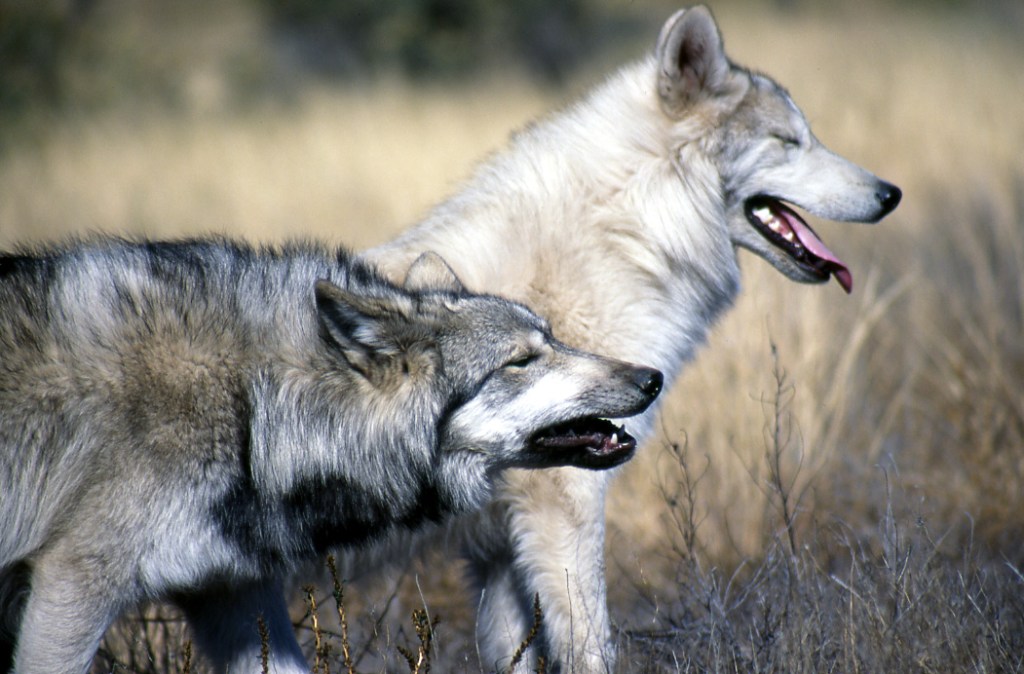
Cover Photo by Caninest via Flikr




Leave a Reply