I am not an engineer. Far from it, in fact. The closest I have ever come to product design is an attempt to make a pen that only works when held in the “correct” way. I didn’t make it of course, I just drew a stick figure diagram on a piece of paper and lost the drive to continue with the project.
I was recently at NEMO Science Museum for the purpose of reviewing it from the perspective of a science communicator. I’ll admit, I was morbidly curious about how it would disappoint me. About how it would it would use generative AI, claiming it to be an inevitable future that will destroy the value of creativity, so you might as well get used to it now. So when, at first glance, I saw nothing of the sort, I was pleasantly surprised.
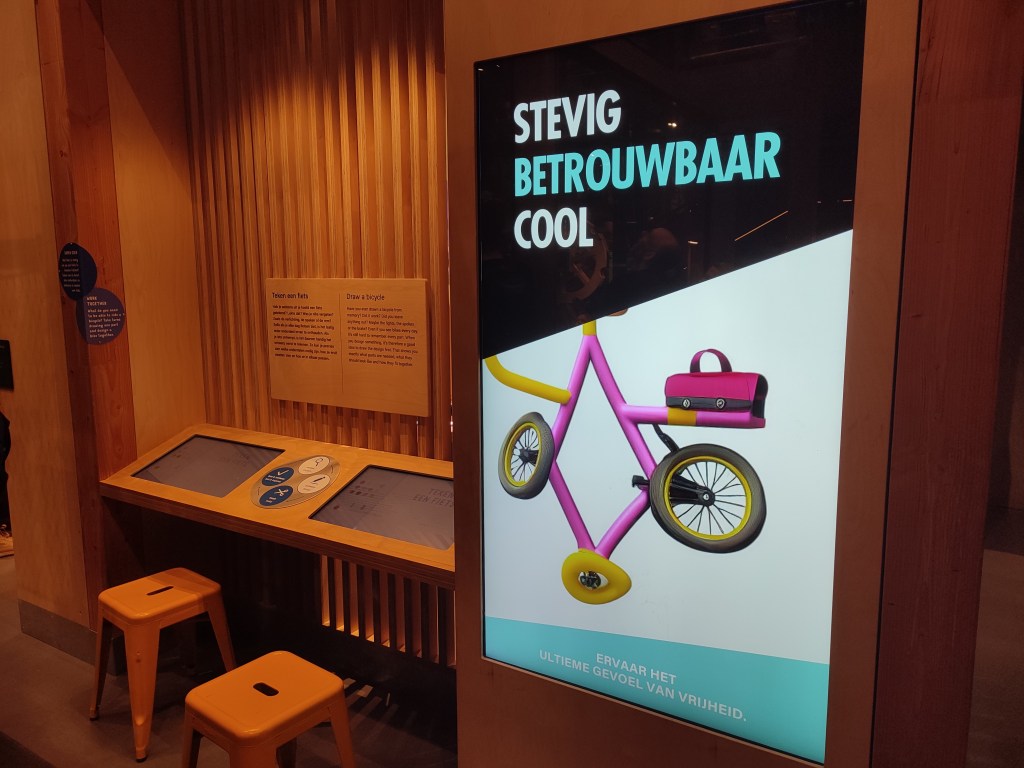
Then my eyes were drawn to an advertisement. “The Bicycle of the Future”, it claimed. I rolled my eyes, disappointed that a venue like this would be forced to take a sponsor. I understood, of course, the rent on a space like this alone must be exorbitant. But then I looked closer and saw it for what it was. The wheels weren’t attached. The saddle wasn’t there. That’s not a real ad.
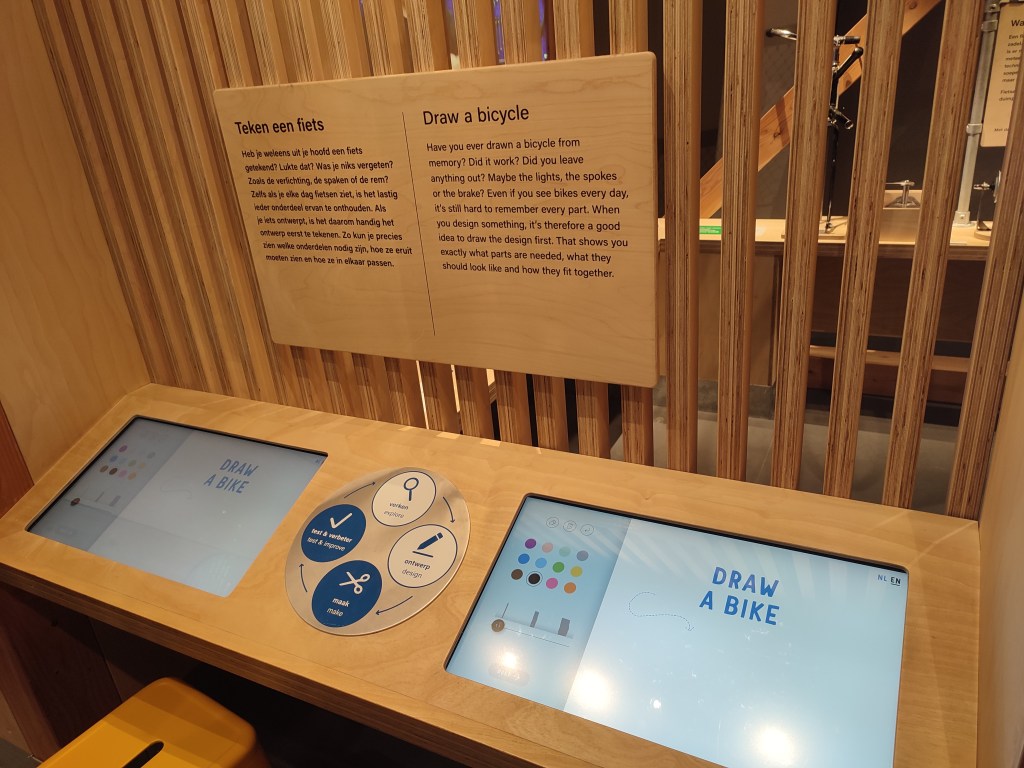
I approached a touch screen, which asked me to do my best to draw a bicycle. Much like my earlier attempt at product design, I just drew a stick figure. I knew that people often had trouble with drawing bikes, they’re surprisingly complicated, so I was very careful to add everything and do it right. I drew the frame, allowing the front wheel to swivel and the back wheel to stay rigid. I drew the wheels, firmly securing the frame to the wheels’ centres. I drew the saddle nice and high and the handlebars bent to be more comfortable to hold. When I was done, I was happy that I’d drawn a functional bicycle.
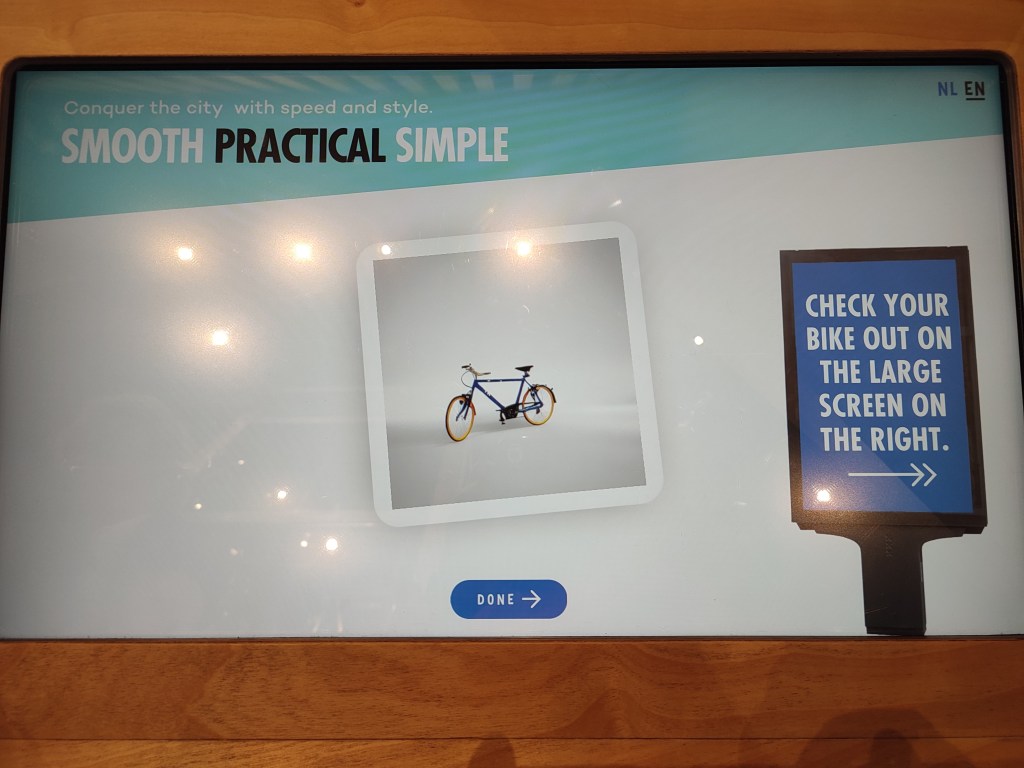
I hit enter and, after a few moments, the computer spat something out. A photo of a bicycle, in a different perspective to how I’d drawn it. It was clearly made by generative AI, with a number of artifacts that simply wouldn’t exist in a real photo. However, I was able to immediately see an issue with the bike I’d drawn: I’d forgotten the pedals.
The computer didn’t offer me any hints, and instead sent me to a page that had a few stock descriptive words that I could apply the bike. At no point did something like Claude or ChatGPT chime in to say, “Wow, what a wonderful first attempt at making a bike! Based on your design, here are some options for improving its functionality.” I was instead told by the exhibit that, if I wasn’t happy with my design, I could try again. Learn from the mistakes that were being shown to me, not told, and make a better bike.
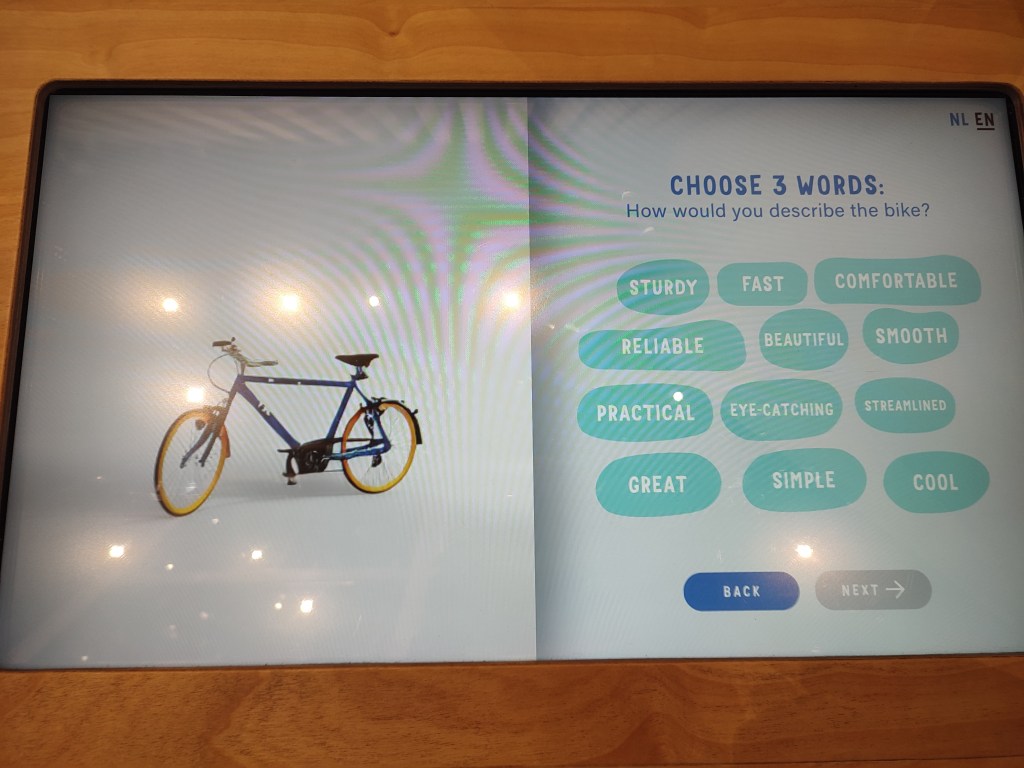
I’ve heard for many years now how generative AI can revolutionise teaching. In this context, it’s always portrayed as chatbots writing lesson plans, answering questions, and just replacing teachers. With this exhibit, I have been shown how generative AI can be used as a tool, create discussions unrelated to the novelty of artificial intelligence, and genuinely improve learning outcomes.
I went to this exhibit alone, and so had to perform my own critique of my design. If I were with someone else, then this could be a shared experience and, for the first time since AI has been introduced, I felt as though it had been used in a way that would have been improved by interacting with others.
I would certainly have less praise for this if it were the only example of iterative design being shown at the science centre, but there were many ways for people to build something, see if it works, and continue building until it does what they want it to do. The fact that this was so accessible, drawing a stick figure and having it come to life as something so complex, sparks creativity in a way that a brief visit to a science centre could otherwise struggle to do. Of course, the most effective intervention would be to build the bicycle themselves with help from a professional. That would be very interesting and fun, but time and resource intensive, thus inaccessible to most people.
I have often wondered at the value that AI actually holds in society at large. I know it can improve accessibility, as the ability for computer vision to describe things it sees is incredible for people with vision impairments. It’s now clear to me that there is value in it as an educational tool as well. I should be very clear, this is a relatively niche case. I do not suddenly believe that generative AI is an unequivocal good and should be embraced by everyone for basically any purpose. But this is not a technology whose only use-case is to maximise productivity and profits at the expense of human creativity.
I will continue to never use AI at any point in the production of my work. I think that it should be avoided as a writer, as a researcher, and as a publisher. Outsourcing this work to AI only serves to make it more difficult to create in the future as skills are lost. The common refrain is, “It’s like riding a bicycle, you never forget.” Well, research indicates that this is a massive oversimplification. If abilities are not maintained through practice, even supposedly simple ones, then they will deteriorate over time. My goal for this (much longer than expected) article was largely to highlight a small shift in perspective that this exhibit gave me, and to hopefully show a bit of optimism for a possible future for this technology.


 Snippets of Science
Leave a comment