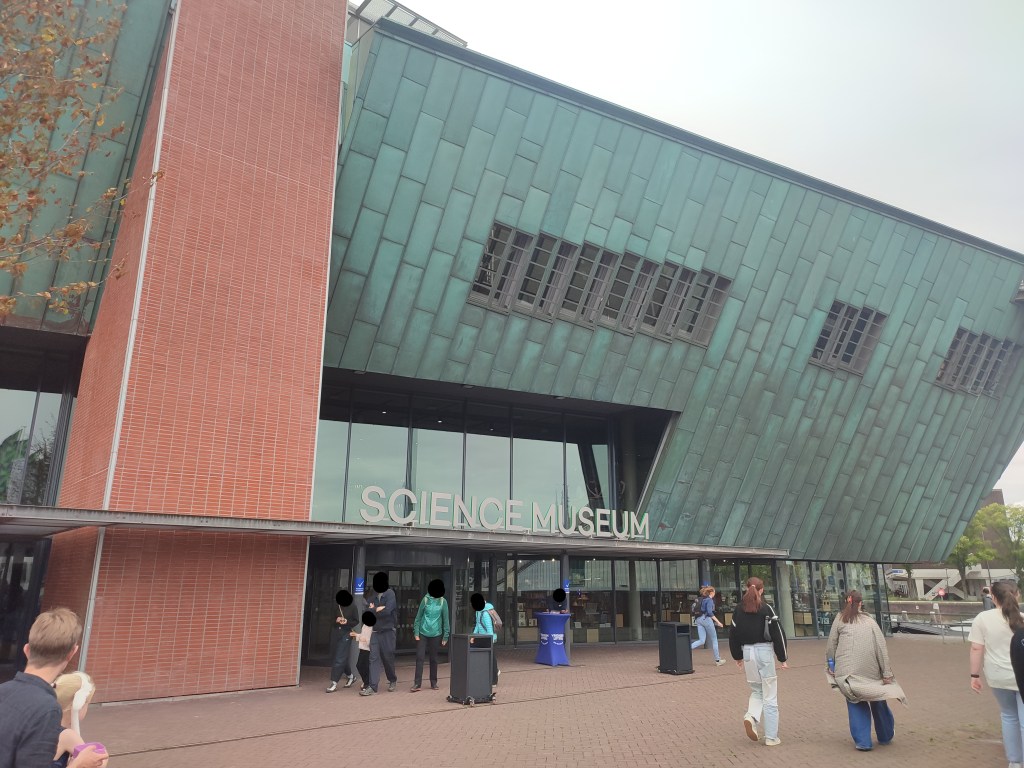
NEMO Science Museum, located only a 10-15 minute walk away from Amsterdam Centraal railway station, is one of the best science centres I’ve ever been to. There are a number of aspects of this museum that facilitate their mission, with only one major issue that I will discuss later. The exhibits were all available in both Dutch and English, though the ability to read either language isn’t a requirement for children in order to be able to enjoy what was on offer (though for some of the more complex activities, having someone in the group who can read one of them helps immensely).
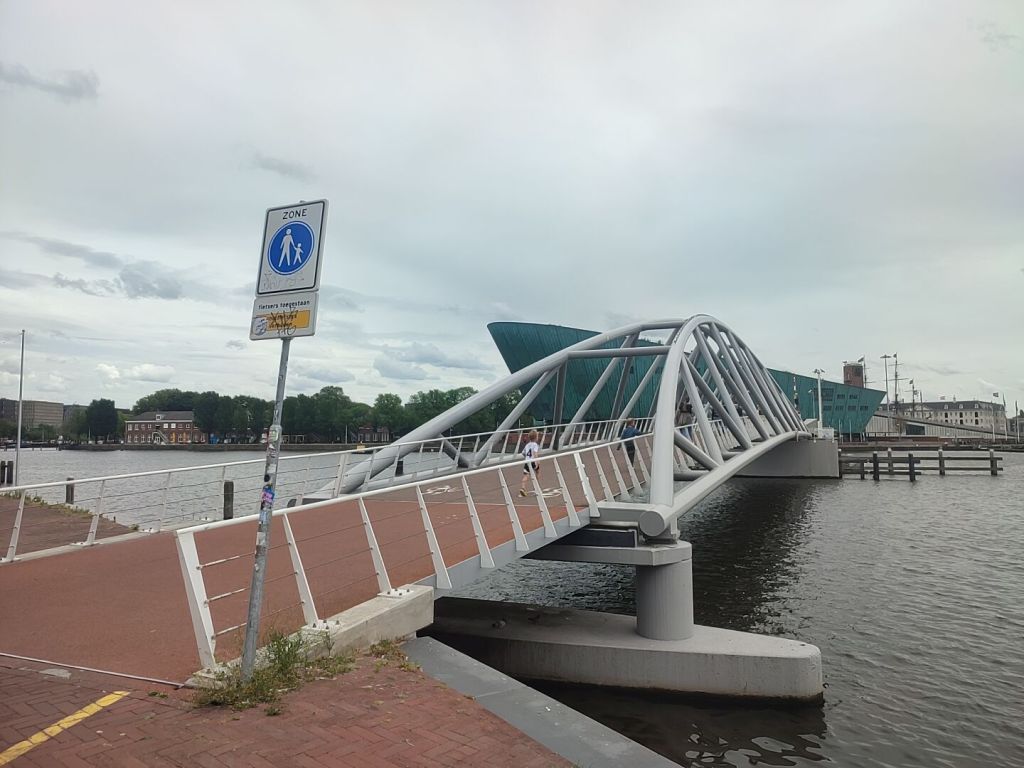
To begin, I will discuss the layout. Apologies to my North American audience, I will be using the European standard of saying that the first floor is the one above the ground floor.
I entered at the ground floor, which has fully step-free access going all the way to the train station. Before any requirement to pay for a ticket (more on those later), there is a large model of a water clock, with information about the origins of the technology and mechanisms that allow it to move and show the time. There is also, of course, a gift shop with science toys, experiments, and branded merchandise. Going through the centre of the museum, a large staircase brings you up from level to level, with each floor also increasing in scientific complexity. Floor 1 is called Fenomena, and deals with physics and movement. Floor 2 is Technium, showing technology. Floor 3 is Elementa, which discusses matter, the universe, and life. Floor 4, my personal standout, is Humania, about the human body, human life, and our cultural conceptions of science. Although the staircase is the main artery of movement, there are easily accessible elevators that, unlike many other museums, doesn’t require a separate key to be allowed to use.
Fenomena
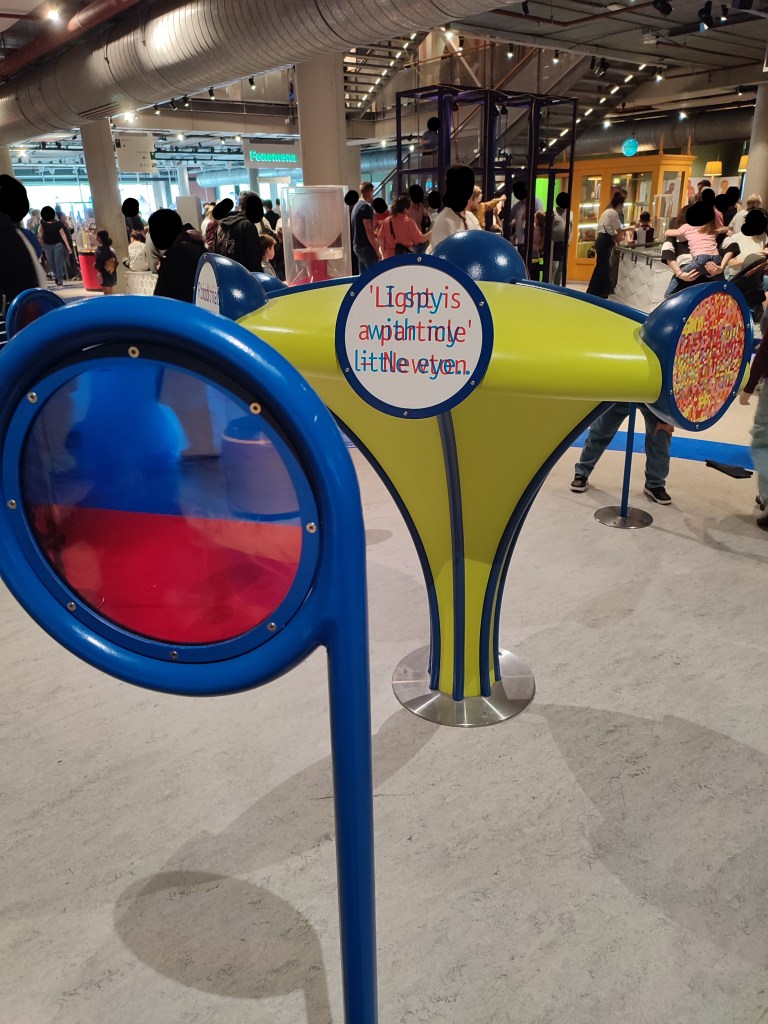
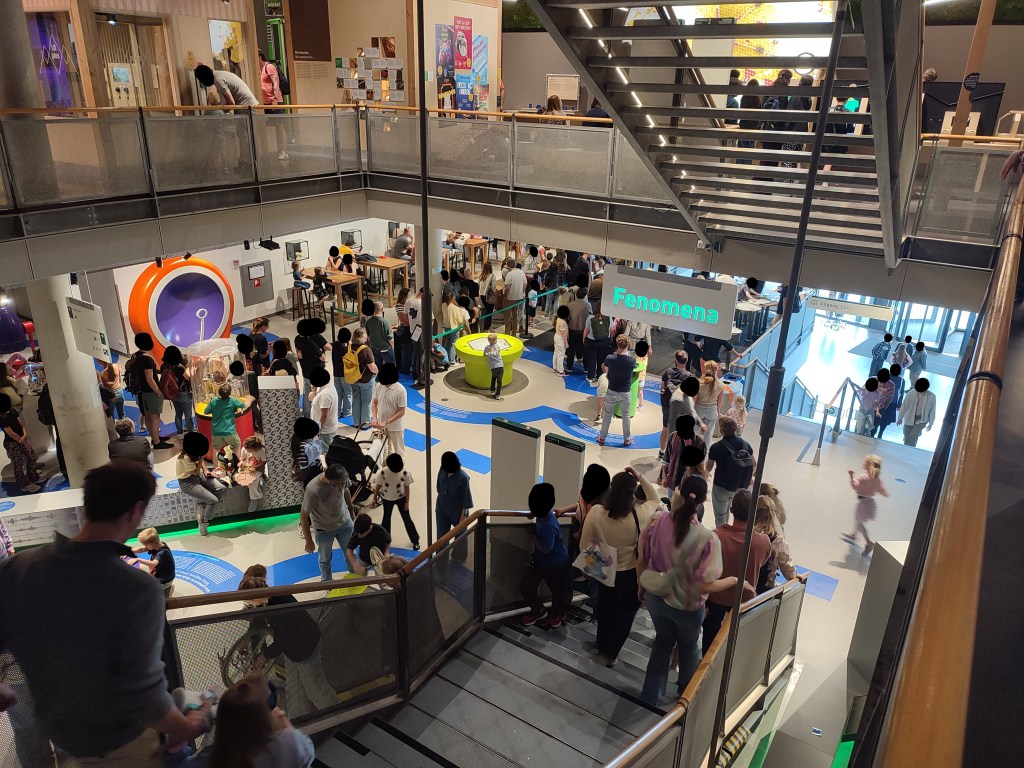
Though earlier I said this area deal with physics and movement, it acts as an introduction to science, what it is, what it can do, how it’s done. What strikes me the most on this level is just how open it is. Children are encouraged by the design to jump from activity to activity, following their whims. There are some exhibits based on rotation and how spinning changes movement. There are no walls set up to attempt to keep them occupied with one thing; if they see something they want to do, they can easily switch over and give that a try. In the areas that may be less suited to things moving and spinning, such as when looking at the exhibits for light and sound, children are instead encouraged to do the moving themselves, running from one part of the exhibit to another to get a look, or listen, at a different point.
The focus point of this floor, and one that climbs up to the floors above, is a large Rube Goldberg machine. This is a device that takes one input and eventually turns it into an unrelated output. If you’ve ever played the board game ‘Mousetrap’, you have an understanding of what these are. Every hour, a presenter goes into the middle of this contraption and brings the gathered audience through a discussion of some of the different kinds of energy, while greatly encouraging verbal participation. When I visited, the presenter spoke both English and Dutch, seamlessly switching between the two and making sure that everyone understood what was happening in a way that felt very natural. Despite my own limited Dutch, I was able to understand everything discussed.
Technium
This floor showcases the progression of technology and how designs come about. Due to the simple factor of there being less space up here, there are fewer opportunities to run around and switch between exhibits. NEMO handles this restriction wonderfully by instead creating smaller areas of interest, each surrounding a theme, and even includes a small design workshop in one of the outer rooms.
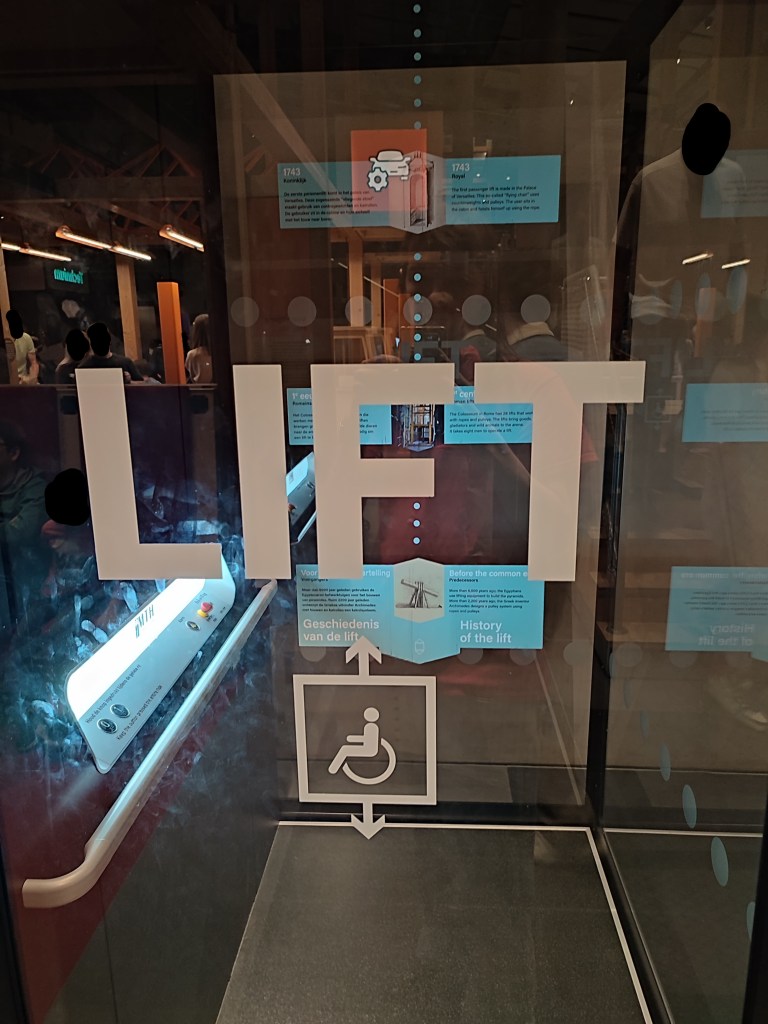
I touched on the general accessibility of the venue earlier, but here is where an example of genuinely inclusive design can be found. On this floor, there is a set of small stairs heading up to a wooden platform, where information can be found about the process of construction. These stairs are thin and difficult to navigate if you don’t have full control over your body. Luckily, the venue provides a glass elevator. Behind the elevator, only properly visible from inside, is a timeline of the history of elevators, beginning with ancient elevators and progressing to the present day as you ascend. This is something that is almost entirely unnecessary, certainly not something legally required, but indicates a genuine attempt from NEMO to let accessibility not be relegated to something in the background, something to hide away.
There was one more exhibit on this floor that stood out to me, however as the main focus of that discussion has expanded beyond this particular review, I am releasing a separate article just for this one. You can find it here.
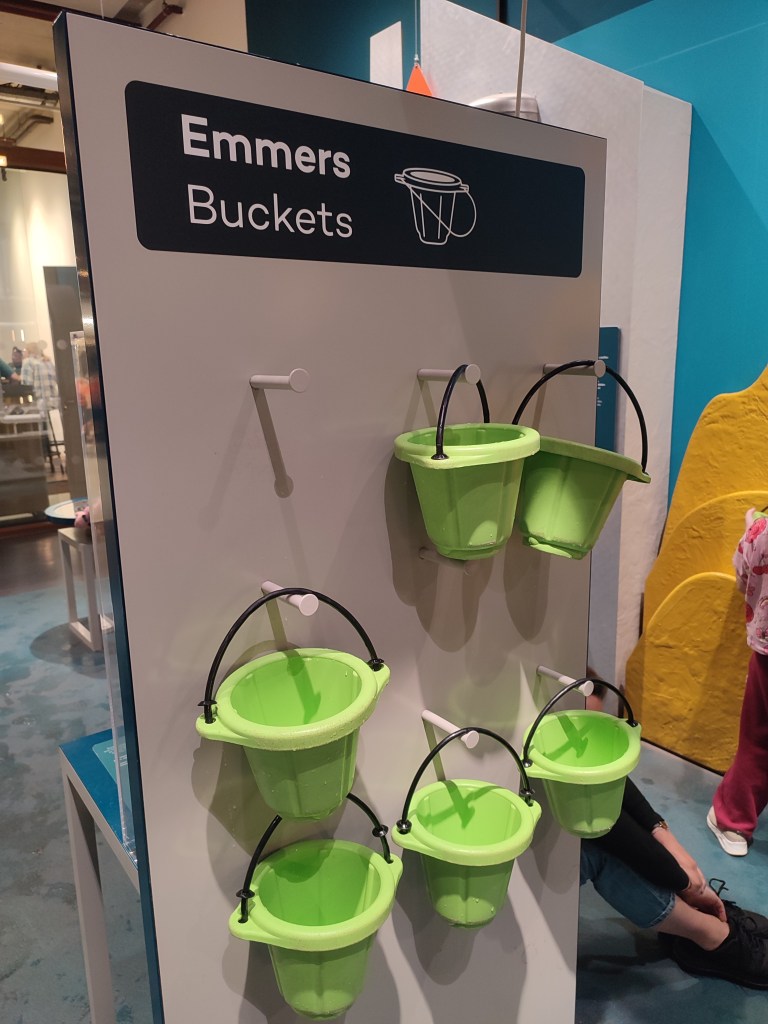
Something that struck me was the trust the centre had in its visitors. There is a section based around water engineering, making dams, etc. On this floor, they have loose water buckets that visitors can fill and use at their discretion. I saw children with these buckets all around this section of the venue, carrying water, pouring it in the appropriate places and just generally behaving and having fun. On the day I visited, the trust was obvious to everyone, and no one wanted to take advantage of it by hurting anyone else or ruining anything.
Elementa
Once again, there is less room for movement here, and I believe this contributes to it being the weakest of the floors. It attempts to strike a balance between the hectic energy from below it with a calmer atmosphere. This didn’t take away from how interesting the individual exhibits were to me, just that it lacked the sense of cohesion that existed on the lower floors. There is a large projection screen that has a game where, as visitors run about a section of floor, they control shields to protect the Earth from asteroids. This is the most physically active exhibit in this section and seems very fun, though I’m unsure of how effective it is in teaching rather than just being a break in the learning to expend energy.
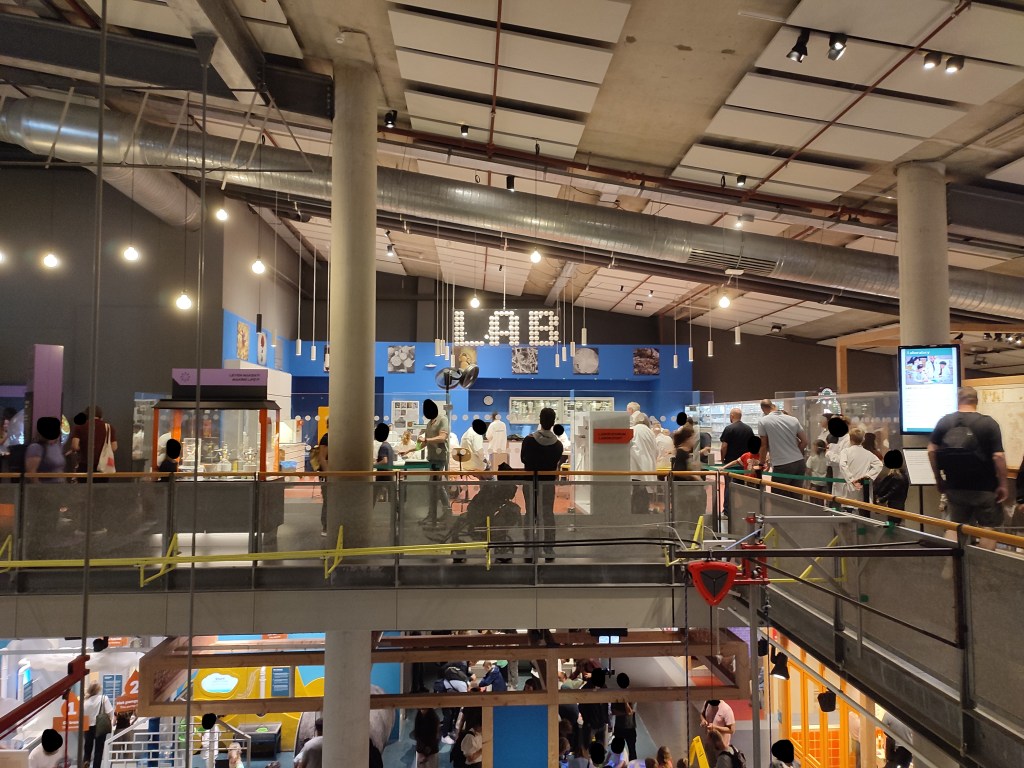
The focus of this section, however, is the Lab, a section where children don lab coats and work with supervision in a lab setting. I did not go in myself, but just standing outside I could smell the familiar scents of a real lab environment. Latex, vinegar, and more mixed together and brought me back to my time in university doing lab work.
This section also contains the ‘life’ exhibit. Though it doesn’t ask it directly, there is an implied question: “What is life?” There is no direct answer given, as with much of the centre. Every aspect of the design of NEMO is to encourage discussion and constructive disagreement. It is very rare that you are simply given an answer without it leading to more open ended questions. The thoughts and ideas of visitors, their preconceived notions, all feed in to their experiences, so despite everyone being shown the same exhibits, they leave taking away a different and personal meaning.
Humania
This was the highlight of the visit for me personally. As a science communicator, I’m always interested in how culture interacts with science, how people are affected by the process of science, and how science can be impacted by the needs of society. This section does so very well and is able to appeal to more mature audiences, with honest discussions of sex, gender, and death. There are still things for smaller children to do, however these require significant instruction and help from the adults they are visiting with.
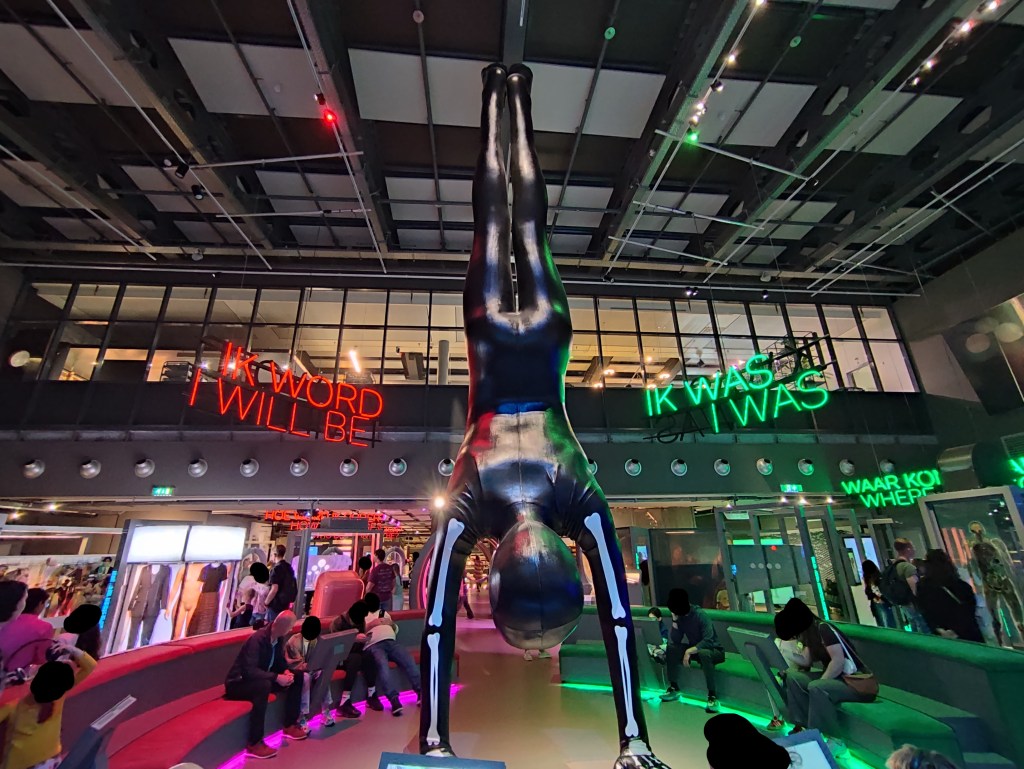
This exhibition reaches to many wide questions, from the origin of humanity to what we do with our lives as we progress in age and development. It excels at what NEMO does best, asking open ended questions that promote discussion among the families that visit, trusting the maturity of everyone who enters and refusing to talk down at them. For other similar venues, this is what should be learned from the most. For a long time, science has believed itself to be the endpoint, where people learn from and bring in to their worldview. Modern science communication theory suggests the opposite, that people’s understanding of the world and themselves influences how they interpret science. It is the role of science communicators, like NEMO, to help promote this sense of science as a part of humanity, responding to our cultures in the way that science has often expected humanity to respond to it. I will have more to say on this subject at a later time, so be patient while I work on it. It’s a big question that deserves more focus than a paragraph in a science centre review.
Issues
The biggest issue at this venue is the crowding. Granted, it’s a science centre in the most populous and tourist filled city in the Netherlands. I went on a Saturday. Of course there are going to be crowds. Crowds can and should still be mitigated. The central arterial staircase cuts straight through the middle of the venue, and so people who are crossing from one side to the other are navigating around people going from one floor to the next. In addition, there is a single entry and exit point in non-emergency situations right at the bottom of these stairs. Almost all traffic passes right at the top of the first set of stairs. The line for meet and greets also can reach out to this section, as it did when I entered the venue, leading to more crowding and difficulty navigating. The presentation with the Rube Goldberg machine causes crowds in the area near where it happens, though there is a brief reprieve in the rest of the venue because of it. The relative openness of the first floor also allows for more people to physically fit in the space, aiding navigation as well. Crowds reduce as you ascend the stairs. Due to crowds, though, I was unable to try out a number of exhibits as they were always occupied by children who were enjoying themselves and often had small lines to use them. The museum’s website recommends visiting on weekdays in the afternoon if you wish to avoid the crowds, so keep that in mind when deciding if you wish to visit.
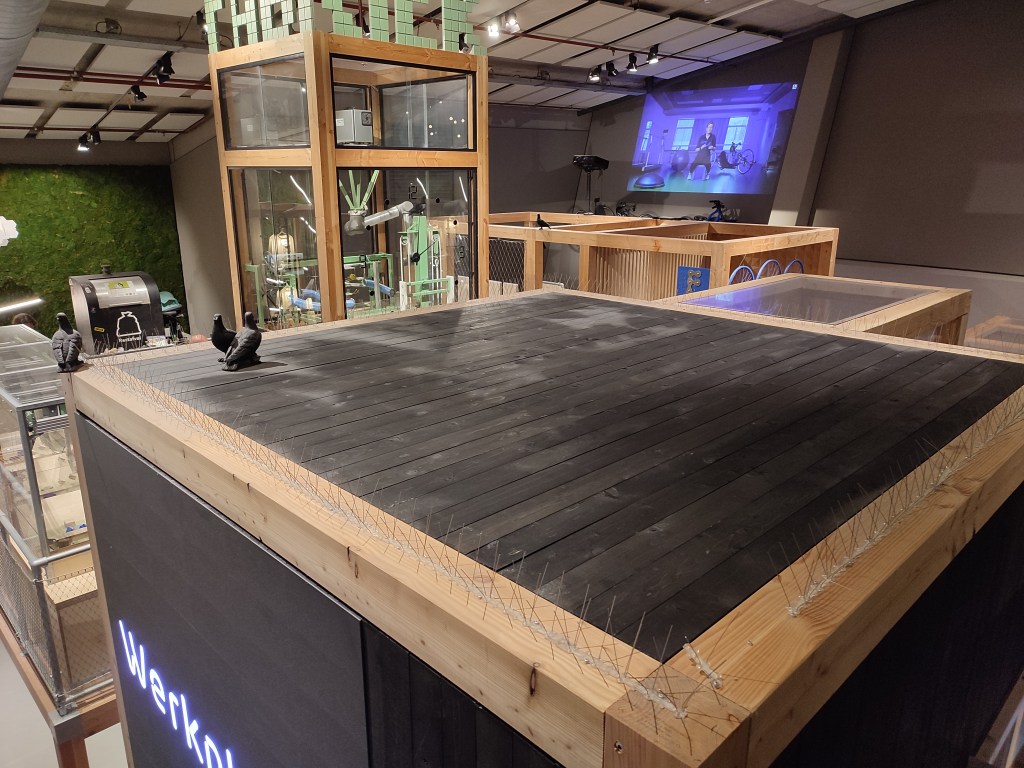
A less severe issue is a small safety one that can be easily fixed. On the third floor, you get a good look at the wooden platforms on the second floor, and you see a lot of decorative bird statues. On one of the wooden platform roofs, there are some of those anti pigeon spikes, a bit of ambience that makes the space feel a bit more lived in. I have my own issues with those spikes, but that is unrelated to my issues here. These spikes are just about in reach of people on the third floor and, as I was writing my notes about them, I saw a child reach over and touch them. Though unlikely, a child could feasibly hurt themselves on it. Those spikes could be easily moved to any other of the wooden platforms and the issue would resolve itself.
Conclusions
If you have a family, particularly if you have children between about the ages of 3-12, I heartily recommend visiting NEMO. It is almost worth a visit to Amsterdam by itself, and you can get hours of fun out of it. If you have a Museumkaart, you are able to go for free. Those without will pay €21.50 per person, with student and youth discounts available. You can find the tickets here.
NEMO is a prime example of science communication at its finest, and remains engaging despite the inherent issues of crowding. I give the NEMO Science Museum a 6 out of 7.


 Snippets of Science
Leave a comment