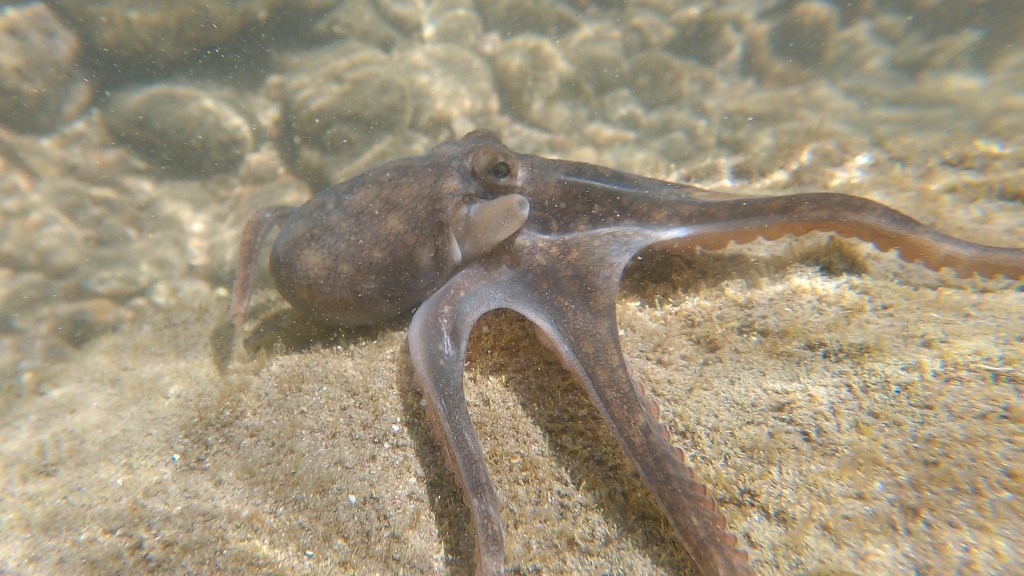
Octopuses are widely regarded to be some of the most intelligent animals on Earth being able to learn to use a number of tools to help them get food or escape danger. A new report in Current Biology has found they are able to use a different kind of tool: a mirror.
Scientists from Dartmouth University were able to show that when presented with a mirror, California two-spot octopuses (Octopus bimaculoides) could identify prey through it and, after some training, correctly move toward it rather than towards the image in the mirror.
It took between 10 and 12 repetitions of the same experiment, where a picture of a crab was shown on a mirror, for the octopuses to stop moving toward the mirror. A picture of a crab was used because octopuses will react to it in much the same way that they will a real crab, without giving them extra information like smell, hearing, or feeling the change in water currents.
This study was very limited in scope, with only three octopuses being trained in this way. Much of the time in science, though, in order to make sure you are researching an issue properly, you need to make sure there is something there to begin. The experiment here has shown that this species of octopus is able to learn how to use mirrors to help with hunting, and it is for future studies to figure out exactly how they use those mirrors. Is it because they are using the mirrors to create a map in their minds? Or could it be because they simply learned that an image in one direction means there will be food in a different place?
Evidence for both of these possibilities was found by the researchers. The octopuses were able to do better and better every time the experiment, almost like they were just learning that the image in one place meant there was a crab in this specific other place. They were also able to show that, using a different layout of mirrors than what they were trained with, that the octopuses were correctly able to figure out where the crab would be. The report is clear that this study was not able to identify which of these is correct.
A lot of our understanding of intelligence and the ability to use mirrors comes from birds and mammals, like us. Octopuses, on the other hand, evolved their brains entirely separate to how we evolved ours, so we are now able to see, for the first time, that a brain very different from ours is still able to solve tasks in a similar way.
Other outlets are reporting this as a novel finding, however this isn’t the first published article on this behaviour by Dr. Kieseler and her team. In October 2020, an abstract (a summary, essentially) was released in the Journal of Vision of an almost identical name, though as it wasn’t a full article, it had a very limited impact, only being cited by one research article when discussing an octopuses ability to learn. I’ve reached out to the author in an attempt to understand this better, but haven’t yet received a reply. I will be sure to update this page when I learn more about this, so be sure to follow on BlueSky, LinkedIn, or Threads, where I will be sure to post when I’ve updated any articles.
Cover Photo by Alberto Alcalá through iNaturalist



Leave a Reply